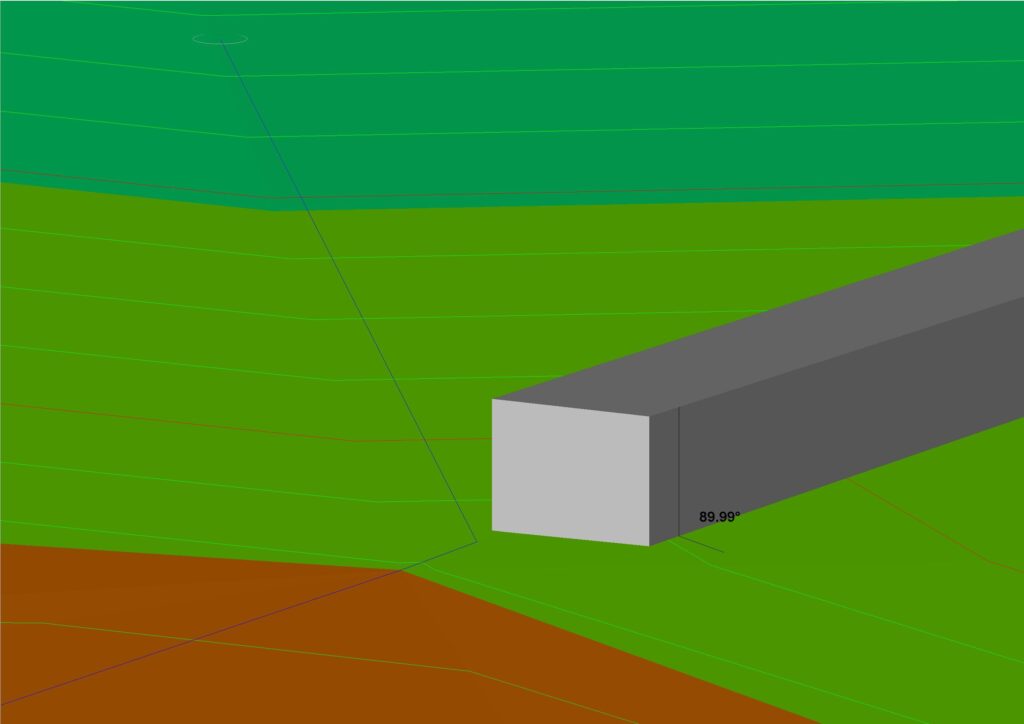
Ever have your terrain model crash when you try to model a vertical face? This is because Triangulated Irregular Network (TIN) surfaces are fundamentally 2.5D rather than truly 3D because they rely on a strict mathematical constraint: for any given horizontal (x, y) coordinate, there can only be a single vertical z-value. Because a TIN connects a network of non-overlapping triangles across a flat plane, it cannot model surfaces that fold over themselves. You may have hit this limitation if you’ve ever had to model a retaining wall, building face, or even a cave. Surveyors commonly cite Top of Wall (TOW) and Bottom of Wall (BOW) elevations at the exact same (x,y,) coordinate. And while this makes perfect sense in the physical world, it clashes with the 2.5D logic of TIN surfaces.
The nifty workaround to modeling a clean, nearly-vertical face, is to apply a negligible horizontal offset (even as small as a few millimeters) between the TOW and BOW points. This slight shift allows the TIN to generate two distinct, highly steep triangles that accurately mimic a vertical structure without crashing.
So, why not just use true 3D models?
The reason TIN surfaces are still used instead of truly 3D models is efficiency. In a truly 3D model, one x,y coordinate can have nerly infinite z values. A 2.5D surface makes calculating cut and fill volumes feasible because the software doesn’t have to guess which “sheet” of earth is being used for the calculation. It also prevents file sizes from being unreasonably large; for many large civil projects a truly 3D model would cause crashes or grind most computers to a halt.